September 16, 2026
The Moat Is Drying Up
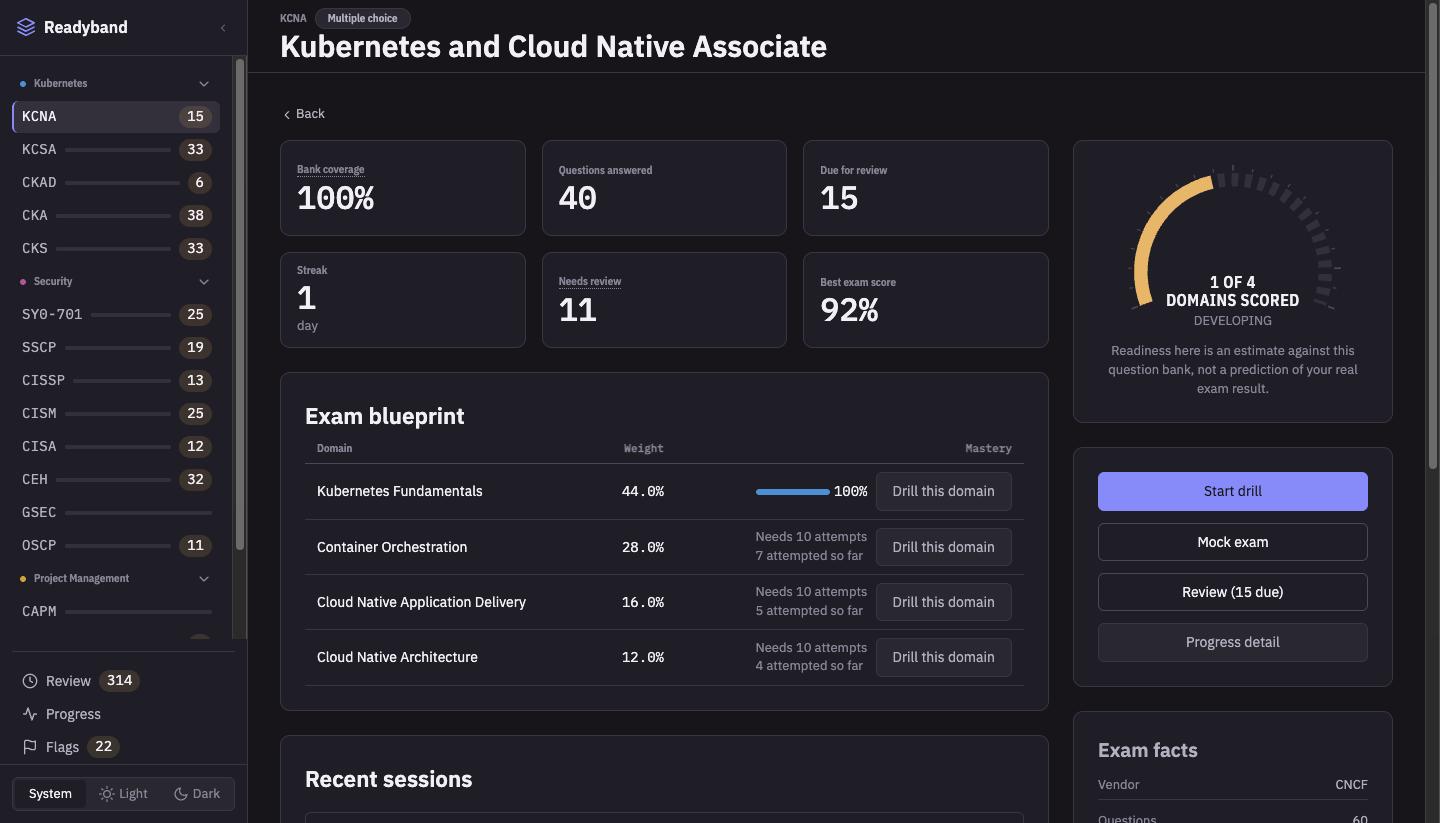
I built a working product this month in eight hours, spread across two evenings. A certification practice site with drills and mock exams, the kind of thing I would have paid a company real money for a few years ago. It works. I use it. If I wanted to sell access to it, I could.
That shouldn’t be possible in eight hours. And the fact that it is tells you something bigger is happening to software than a productivity bump.
TL;DR
- Software used to be a moat: years of schooling, then years more of hands-on experience, before a person had the expertise to build complex applications. AI has drained a lot of that moat, fast.
- I built a working certification-practice site with drills and mock exams in about eight hours over two evenings, something I'd previously have paid a company for.
- If software stops being the moat, something else has to be, and I think it's data, which is why companies that don't lock theirs down are handing away the only thing AI can't already generate on its own.
The software industry has relied on a moat
A castle moat wasn’t built for its beauty. It served as a strategic defense mechanism. It provided a time advantage and made attacks costly enough to deter most potential adversaries.
Similarly, software development has always been a challenging field. Its moat has typically been related to education and experience. Years of formal education and practical experience were essential to overcome this formidable obstacle. Those who have successfully crossed it have become invaluable assets to organizations. In return, organizations have been willing to pay a premium for the expertise and skills of these highly skilled professionals.
The moat is what’s actually shrinking
For the past year, I’ve been leaning more and more towards the idea that software’s moat is almost dry, and it won’t be long before it’s completely dry. It’s become almost trivial for a single person with zero education or experience to build an incredibly complex project that would’ve been impossible for them just two years ago. But I had not yet experienced a scenario where I felt like something had changed in a substantial way.
That changed when I built the aforementioned certification site in such a short period of time. My goal was simple: I wanted to sharpen my Kubernetes, security, and project management skills but wasn’t interested in buying a subscription to somebody else’s practice platform. I decided to see if I could just build my own, i.e., real drills, real mock exams, tracking, all of it. It took two evenings, four hours each evening, for a total of eight hours. It works, is fully functional, and highly modular with the ability to add more exams over time. It’s the kind of practice exam platform that existing organizations charge a monthly fee for.
That’s not a story about me being clever to avoid paying money for a service. It’s a story about what used to require capital, a team, and months of work now requiring an evening and a clear idea of what you want. Don’t get me wrong: experienced engineers still have a real edge here, knowing what to build and how to check the output is still worth a great deal. But that edge is thinner than it was a year ago, and honestly, thinner than it was even a month ago, and I don’t think it holds forever either. The water is evaporating quickly and it’s just a matter of time before it’s trivial to cross over the moat.
But, to be perfectly clear here: I’m not saying this is all doom and gloom. An engineer’s skill and experience don’t disappear because the moat is dry, but it instead moves up a level, the same way it moved when compilers took over from hand-written machine instructions. What’s different this time is how far up the ladder that move reaches. It’s not just changing how developers work. It’s removing the reason a lot of software companies could charge money in the first place.
I’m now of the opinion that engineers are not in danger, but honestly believe a lot of the software companies we know, use, and sometimes love are in real danger of not being relevant any longer. I’m working on another project to see if specific companies are actually at risk here, but I’ll leave that for a future post.
Why this makes people uncomfortable, including me
I’ve felt uneasy about the approaching AI change for a couple of years now, and I don’t have it resolved in my head quite yet. I don’t know exactly what my job looks like in five years. My wife works in a completely different field, and she’s asking herself the same question about her own work. I think almost everyone is going to be asking it soon, if they aren’t already.
I think the discomfort I’m feeling is reasonable. It’s not the same feeling as a punch-card programmer being annoyed that compilers existed. This is closer to watching the actual floor you built your career on start to move. I don’t have a tidy answer for where that leaves me, and I’m suspicious of anyone who claims they do. For now, I’m just going to keep building things, pay attention to where this all goes, and figure out my next move as it gets clearer. I know that’s not a satisfying answer. It’s just an honest one.
If software isn’t the moat, what is
To be clear, I’m confident that moats will continue to exist. But it’s not going to be software moving forward. Instead, I think the moat moves on to data. Let me explain.
Most major models have already ingested the readily available internet. Meta’s own paper on LLaMA lays out the mix: Common Crawl, GitHub, Wikipedia, books, ArXiv, all scraped, filtered, and folded into training (Touvron et al., “LLaMA: Open and Efficient Foundation Language Models”). The next round of gains has to come from somewhere, and I expect AI companies, OpenAI, Anthropic, Google, Microsoft, and whoever else is still standing, to start paying for it directly: licensing deals, human data-labeling contracts, arrangements to farm fresh, real-world data instead of recycling what’s already been scraped.
I’d be careful about the alternative, which is training on AI-generated data. Researchers already have a name for what happens when a model trains on its own output, or another model’s output, across successive generations: model collapse, where the model gradually loses the rare, real-world detail in its data and drifts toward generic, repetitive output (Shumailov et al., “AI models collapse when trained on recursively generated data,” Nature). That’s not a hypothetical risk. It’s a documented one, and I don’t think anyone serious wants to lean on synthetic data at scale until it’s better understood.
That’s why data is becoming the thing worth protecting, and companies are already reacting like it. Cloudflare started blocking AI crawlers by default in July 2025 and opened a marketplace, Pay Per Crawl, where publishers can charge AI companies per page instead of letting them scrape for free (Cloudflare, “Cloudflare Just Changed How AI Crawlers Scrape the Internet-at-Large”). The New York Times sued OpenAI and Microsoft back in December 2023 over the exact question of whether millions of its articles could be ingested for training without permission or payment, and that case is still working through discovery in the Southern District of New York (Wikipedia, “The New York Times v. Microsoft and OpenAI”). Neither of those is a hypothetical. They’re companies figuring out, in real time, that their archive is worth more locked than open.
If you run a company sitting on any kind of proprietary data, customer behavior, internal documentation, years of support tickets, sensor readings, whatever it is, that data is closer to your actual moat now than your codebase is. The codebase can be rebuilt by a competitor with a laptop and a weekend. The data can’t, as long as you keep it yours.
Key Takeaways
- The old software moat, years of schooling plus years of scars, is draining fast. I built a working certification-practice product in eight hours as proof to myself, not just a claim.
- The open internet has already been scraped. The next round of AI progress depends on new data, and companies like Cloudflare and The New York Times are already treating their own data as the thing worth protecting.
- If your company has proprietary data, that's your real moat now. Software isn't, and it's getting less defensible every month.